
LVL beam depth and stiffness are linked through I, the section’s second moment of area. Bending stiffness is E × I, where E is the product’s elastic modulus. For a rectangle, I grows with depth cubed at fixed width. In a geometric example, increasing depth from 225 mm to 300 mm gives 2.37 times the bending stiffness at unchanged width and shear-free E. This does not set an allowed span. Loads, supports, shear, bearing, restraint and service limits still need a product-specific design.
Separate stiffness from strength
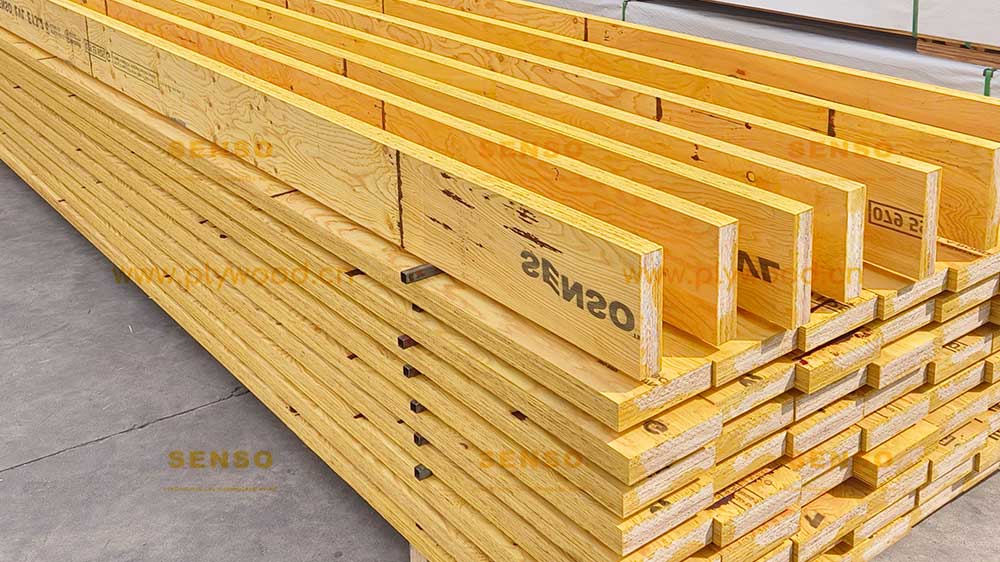
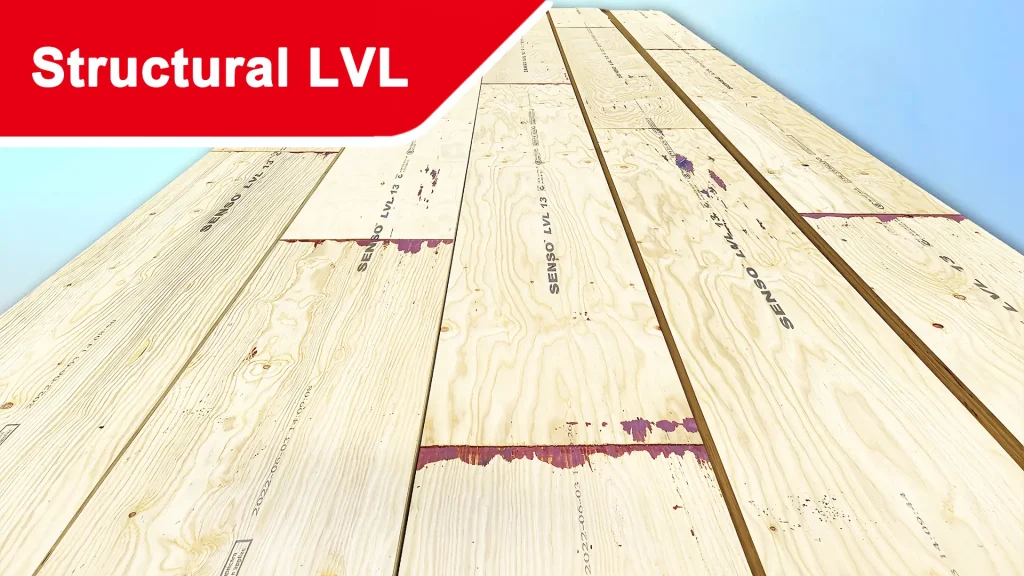
LVL is laminated veneer lumber: thin wood veneers bonded with the grain mainly along the member. So use the named product’s design values for the stated load axis.
Stiffness tells you how much a beam moves under load. Strength sets the stress it can resist under the design rules. However, a beam can pass a strength check and still sag too much for a floor, ceiling or finish.
Compare LVL beam depth and stiffness using the full section. For a solid rectangle, the main geometry terms are:
- I = bh³/12: second moment of area, often called moment of inertia, in mm⁴.
- Z = bh²/6: elastic section modulus, in mm³.
- EI = E × I: bending stiffness; E in N/mm² gives EI in N·mm².
Here, b is width and h is depth in the bending plane. The USDA Wood Handbook’s structural analysis chapter sets out the section formulas. However, Z only describes the shape used in a bending stress check. The LVL strength grade still needs product data.
Compare LVL beam depth and stiffness at fixed inputs
This original example uses three chosen rectangular sections. First, hold span, simple supports, total uniform line load and shear-free E constant. Also assume small elastic movement. Exclude shear movement, creep and joint slip to isolate bending.
| Section b × h (mm) | Area ratio | I and EI ratio | Z ratio | Bending deflection remaining |
|---|---|---|---|---|
| 45 × 225 | 1.00 | 1.00 | 1.00 | 100% |
| 45 × 300 | 1.33 | 2.37 | 1.78 | 42.2% |
| 60 × 225 | 1.33 | 1.33 | 1.33 | 75.0% |
Calculated ratios relative to 45 × 225 mm; rounded values. These are geometric examples, not stock confirmations, tests, load ratings or approved spans.
Both larger sections have the same area. However, the deeper option gains more bending stiffness than the wider option. Its I ratio is (300/225)³, while its Z ratio is (300/225)².
At equal length and density, both larger sections use 33.3% more wood and have 33.3% more self-weight. The table holds load fixed. Therefore, update self-weight in the real load case. Our LVL beam sizes comparison guide supports the next section check.
A stiffness gain is not a span multiplier
For a simply supported beam under a uniform line load, bending-only midspan movement is:
δb = 5wL⁴ / (384EI)
Use consistent units: w in N/mm, L in mm, E in N/mm² and I in mm⁴ give δb in mm. This formula uses shear-free E and omits shear movement.
Span enters to the fourth power when line load stays fixed. Therefore, a 2.37-fold stiffness gain cannot be read as a 2.37-fold span gain. The chosen deflection limit also changes the result.
Use the LVL beam span tables page for the selection framework. Accept a numerical row only when a current, engineer-reviewed table covers the exact product and whole load case.
Check the E value behind the quote
Before comparing LVL beam depth and stiffness, ask which E the data sheet states. Apparent E includes shear effects in the measured movement. However, true, or shear-free, E describes bending without those effects.
APA’s guidance on apparent and true E explains why the basis matters. Ask the designer which E their method needs. Use the same units in both quotes. Do not add or omit shear movement by guesswork.
| Data field | Unit or record | Check before comparison |
|---|---|---|
| Product, section and axis | Code; width × depth in mm | Exact grade and installed orientation |
| Elastic modulus E | MPa or GPa | Apparent or shear-free; test method and basis |
| Bending, shear and bearing | MPa | Declared values and relevant design factors |
| Loads and supports | kN/m; kN; drawing detail | Same load cases and support model |
| Movement limits | mm or stated span ratio | Short-term, long-term and floor response checks |
| Density and exposure | kg/m³; moisture and use records | Weight basis and permitted site conditions |
Requested data fields, not declared SENSO performance values. No industry-typical E or density is substituted for product data.
Keep the evidence types clear. A section size is a specification. Our ratios are calculations. A standard gives requirements. A single test result covers its samples and conditions; it does not establish every beam’s design properties.
Choose beam depth around the job’s limits
Floors, roof beams and opening beams can need different service checks. For example, a floor may need a vibration check as well as static sag. A roof member may also face uplift. Extra depth does not remove those checks.
| Change | Main bending effect | Practical limit to review |
|---|---|---|
| Increase depth | I grows with h³; Z with h² | Headroom, restraint, holes and connection fit |
| Increase width | I and Z grow with width | Wall width, bearing and fixing space |
| Use a higher E | EI rises with E | Same E basis; separate strength checks |
Selection effects for a solid rectangular member under the stated bending assumptions. No option is a project approval.
For LVL beam depth and stiffness, compare the gains with what the site can accept. Also check bearing, support strength and lateral restraint. A deeper member cannot repair a weak support or an unapproved connection.
For short or deep beams, shear movement may matter. In addition, long-term loads and moisture can change sag. Use only the named product’s hole, notch and exposure rules.
Verify LVL beam depth and stiffness evidence
For Australian work, AS/NZS 4357.0:2022 covers LVL manufacture, structural characterisation and verification. AS 1720.1:2010 provides timber design methods. Then confirm the editions and amendments required for the project.
Ask for the current certificate or assessment, its issuer, scope, grade and named production site. Next, check the property sheet’s revision, test method, load axis and moisture basis. Match delivered beam and pack marks to those records.
An E-grade label alone is incomplete evidence. Our structural LVL decision guide connects grade, product identity and intended use. Also check current supply and site limits for the exact SENSO Frame LVL quoted.
Put the comparison into the LVL enquiry
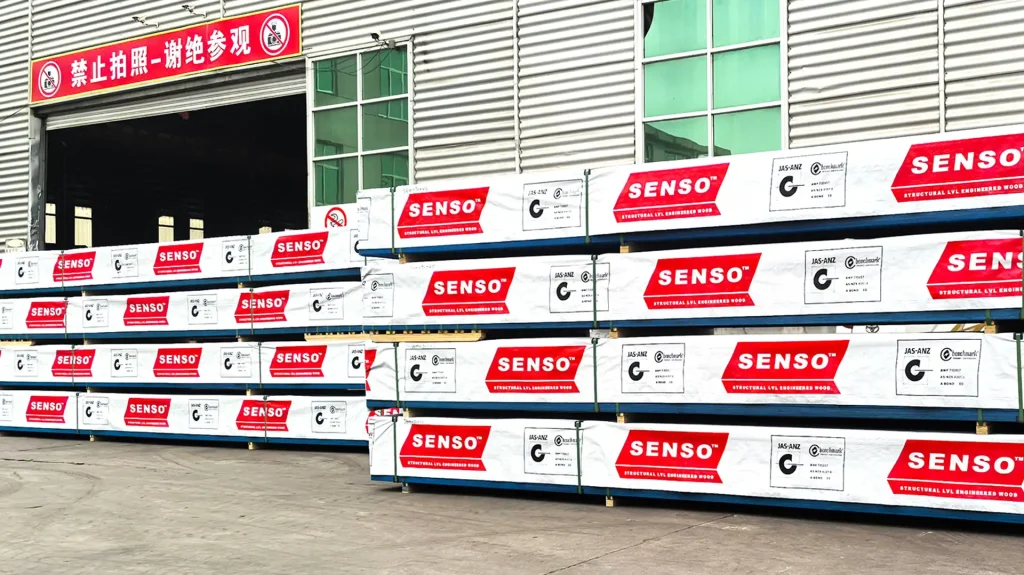
For SENSO enquiries about LVL beam depth and stiffness, send:
- Span, beam role, loads, point-load positions and support drawings.
- Product, grade, width × depth, load axis and any depth limit.
- Required movement limits, restraint, bearing and fixing details.
- Exposure, treatment, cut lengths, quantities, delivery location and required delivery date.
Also state the E basis used by the designer and the quote’s supply scope. Then compare timber, fixings and site work together. The designer must accept any change to the specified product or section before ordering.
LVL beam depth and stiffness questions
Does a deeper LVL beam always allow a longer span?
No. Greater depth can improve bending stiffness, but shear, bearing, restraint or another limit may control. Use a checked design for the whole case.
Does a higher grade always beat a deeper section?
No. Compare EI using matching E data, then check strength and site limits. Grade and section size solve different parts of the job.
Can I lay the same LVL beam flat?
Only if the design covers that orientation. Rotating the section changes its geometry and may change which product properties apply.
Is the 2.37 ratio a SENSO test result?
No. It is an original geometric calculation for depth changing from 225 mm to 300 mm at fixed width and E.
Does extra depth increase beam weight?
At fixed width, length and density, weight rises with depth. Confirm actual mass using the supplied product’s density and moisture basis.
Can a deeper beam accept larger service holes?
Do not assume so. Use current product hole rules or a project detail that checks size, position and spacing.
What proves LVL beam depth and stiffness in a quote?
The exact section and load axis, plus a current property sheet with the E type and basis. These must match the designer’s method.
Send the span, load and support conditions for preliminary product guidance. Contact us about SENSO Frame LVL with drawings and section options. The project designer must approve the final beam and connections.
Post time: Oct-26-2026