

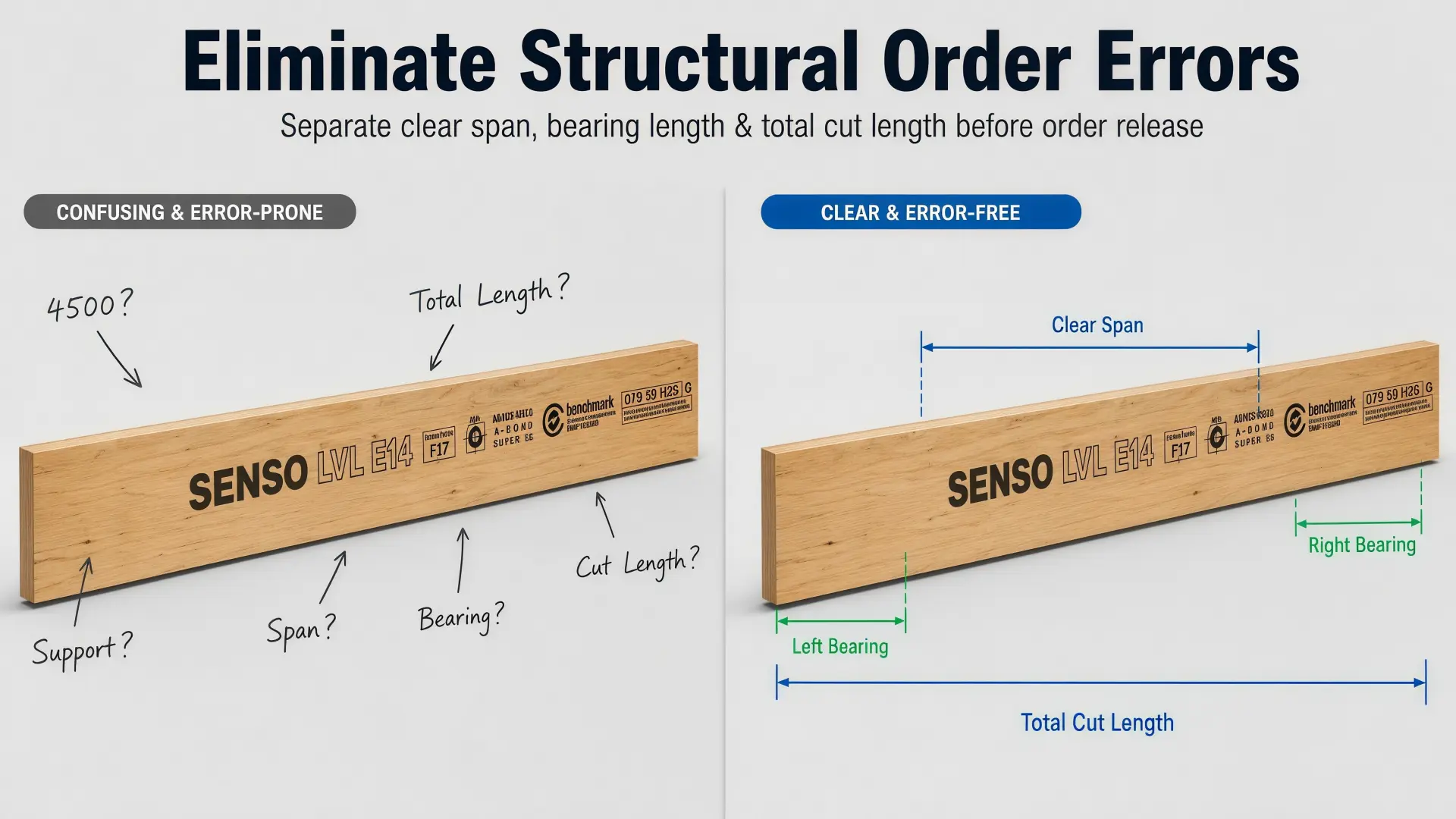
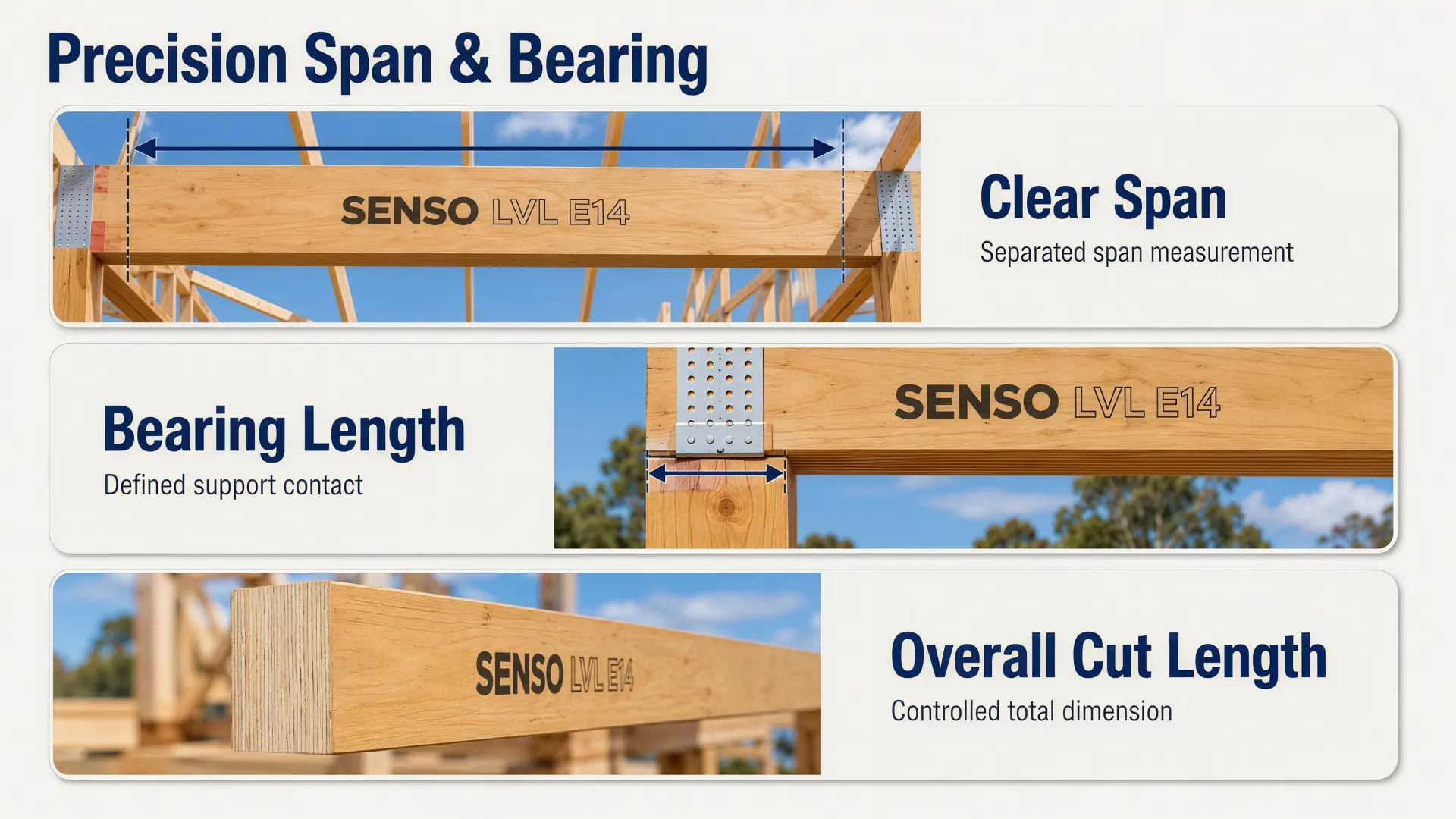
LVL clear span and bearing length name different parts of one beam. Clear span is the gap between support faces set by the current drawing or span table. Bearing length is the contact length at each support. Overall order length is the end-to-end cut length. For a straight beam with square ends and no overhang, it may equal clear span plus left and right bearing. Check that shape before using the formula. Never assume one bearing length fits all jobs. End loads, product data, support type, site use and the design code set it.
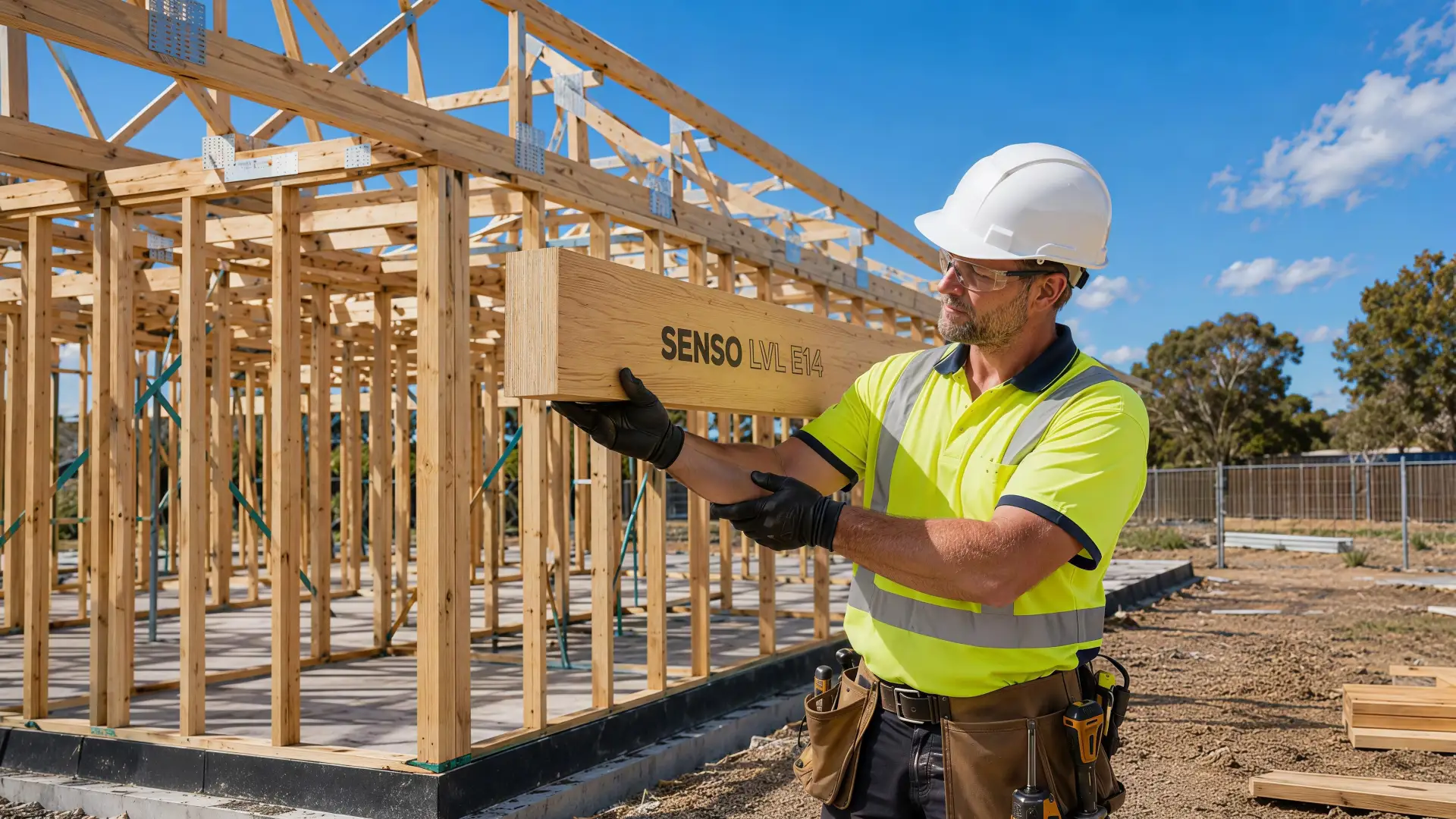
Buyer rule: Do not send one figure called “beam length.” Name the length, its end points, its unit and the drawing issue.
LVL Clear Span and Bearing Length Definitions for Buyers
A span check and a cut note answer different questions. The first checks the gap between supports. The second tells the mill what to make. So, LVL clear span and bearing length must stay in separate fields.
| Dimension | Working definition | Main use | Common error |
|---|---|---|---|
| Clear span | Unsupported distance between the support faces named by the current document | Beam check or approved span-table lookup | Using support centres or an unchecked opening |
| Left and right bearing | Contact length at each support | Reaction transfer and support check | Assuming equal ends or a generic minimum |
| Overall beam length | Finished end-to-end cut length | Quotation, cutting, packing and fit | Ordering clear span as finished length |
| Structural opening | Opening shown on the relevant plan or detail | Coordination with walls, posts and finishes | Treating it as clear span without proof |
The controlled LVL beam span tables owner page should state how it measures span. Use that rule for its rows. But record any other project baseline before release.
The same three fields apply to floor beams, roof beams, lintels and bearers. Yet each member uses its own load and support detail.
Record LVL clear span and bearing length in one controlled formula
For a square-ended simple beam with no overhang and supports below both ends, use this order check:
Overall cut length = clear span + left bearing + right bearing
This checks size, not design. It does not choose either bearing or prove that the beam and supports work.
For example, a buyer copies an opening into a purchase order and calls it “length.” The mill cannot tell if this means span or cut length. The cut beam may then miss a support. Instead, stop and obtain the clear span, both checked bearings and the overall cut length. Do not guess a beam size or bearing value.
How LVL Clear Span and Bearing Length Change the Checks
Clear span affects bending, shear and sag. Bearing length affects how the end load enters its support. Overall length controls fit and handling. As a result, a mix-up in LVL clear span and bearing length can harm both design and cutting.
| Check | Key dimension | Must also match |
|---|---|---|
| Span and sag | Clear span | Use, loads, section, grade, restraint and site state |
| End reaction | Bearing at each support | Reaction, width, product data, support and connection |
| Cutting and fit | Overall length | End shape, pockets, hangers, overhang and tolerance |
| Freight and lifting | Overall length | Piece mass, pack support, route and unloading plan |
Let the load path set the bearing check
The end load comes from the real load path. AS/NZS 1170.1:2002 sets design values for permanent, imposed and other actions. Next, the engineer applies the right load cases.
The bearing check then uses the named LVL data and support detail. AS 1720.1-2010 sets methods to design and accept timber structures. But it does not create one support length for every LVL order.
- First, check each end load because the two ends may differ.
- Then name timber, steel, masonry, concrete or the checked connector.
- Also check beam width, load direction and product design data.
- Finally, list site moisture, treatment, holes, notches and edge damage.
So, mark any open bearing “design pending.” Never turn a sales estimate into a released cut length.
Match the product documents to the support detail
LVL is an engineered wood member built from bonded veneer layers. Still, the generic name does not supply project design data.
AS/NZS 4357.0:2022 covers LVL manufacture, structural characterisation and checks. But a standard reference alone does not approve a beam or its end bearing.
Ask for files that name the product, grade or property set, source, standard edition and marking system. Check their scope and date. Then match them to the support check. The structural LVL decision guide shows why product identity and use must stay linked.
For example, a SENSO order should cite the data and records for the quoted product. A test or certificate for another grade, plant or product is not proof for that beam.
Recognise details where simple addition fails
| Detail | Why the formula may fail | Order action |
|---|---|---|
| Cantilever | Timber extends past a support | Show support line and overhang |
| Hanger or steel shoe | Connector shape defines support | Name the approved connector and revision |
| Wall pocket | Insertion, clearance and bearing differ | Dimension each item |
| Skewed or sloping end | Length changes with the baseline | Issue a dimensioned shop drawing |
| Continuous beam | Several spans and supports apply | Show every support point as defined |
| End notch or hole | Material leaves a high-reaction zone | Get written approval before cutting |
Audit the supplier’s cut-length controls
A certificate does not show that the current drawing reached the saw. So, mill checks for LVL clear span and bearing length must cover drawing release and length checks.
| Audit point | Evidence | Hold point |
|---|---|---|
| Drawing control | Approved revision tied to each member mark | Stop if revisions differ |
| Measurement control | Calibration status for tapes, stops or systems | Stop if expired or missing |
| First piece | Recorded length, end detail and mark | Accept before the full run |
| Traceability | Product, grade, batch and piece or bundle ID | Separate unverified stock |
| Nonconformance | Quarantine, review and disposition record | No unapproved recut or repair |
| Pack support | Bearers, straps, end cover and handling plan | Correct exposed or unsupported packs |
Use the LVL beam sizes comparison guide to sort section and length options. Still, confirm stock, tolerance and cut service for the quoted SENSO product.
Add LVL Clear Span and Bearing Length to the RFQ
First, use one row per member mark. It keeps LVL clear span and bearing length in view. But release only checked cut data.
| RFQ field | What to state |
|---|---|
| Member | Mark, role, quantity and project zone |
| Product | Named LVL, grade or property set, treatment and records |
| Section | Finished width × depth and source |
| Span | Clear span, unit, measurement points and drawing revision |
| Supports | Left and right bearing, support material and connector |
| Cut work | Overall length, end shape, holes, notches and tolerance |
| Site state | Interior, protected, exposed or treated use |
| Logistics | Mass source, pack limits, delivery length and unloading |
| Release | Budget, review or approved for manufacture |
Questions buyers ask about LVL order dimensions
Do LVL clear span and bearing length equal the wall opening?
No. An opening and the gap between supports may use different end points. So, follow the current beam detail and its terms.
Can I add two bearing lengths to get the order length?
Only for the simple geometry stated above. Hangers, pockets, skewed ends and cantilevers need a detailed check.
Is there one minimum bearing length for every LVL beam?
No. End load, beam data, support data, joint, site state and design method all matter. Use a checked detail or project check.
Does a longer beam carry more load?
No. The model, product, section, load, bracing and supports set what the beam can carry. Extra timber may only form an overhang.
Can the supplier choose bearing from the beam depth?
No. Depth does not state the end load or support strength. The project engineer should approve both supports and joints.
What if the two end bearings are different?
List both ends separately. Also name each support and drawing detail. Never average them or copy one value.
What should I send with a SENSO quotation request?
Send the beam list, current drawings, beam role, loads or checked choice, product, section, supports, cut lengths, treatment, quantity, destination and needed records.
Send the LVL clear span and bearing length, loads and support details for preliminary product guidance. Contact SENSO with the drawings, cut list and project location. A qualified project designer must approve the final member, bearing and connection before manufacture or site work.
Post time: Sep-28-2026