
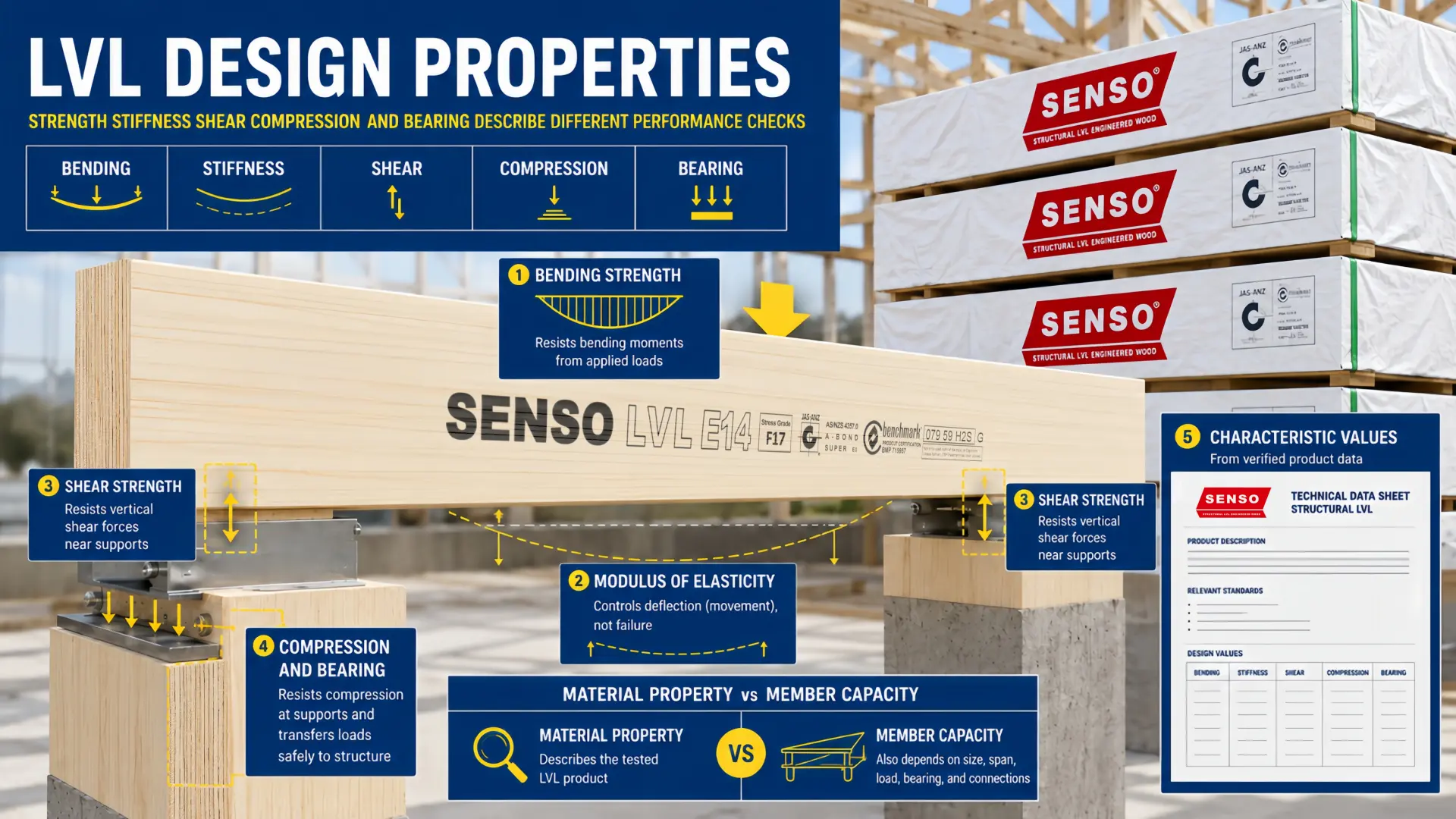
LVL design properties are the verified material values used to judge how laminated veneer lumber responds to bending, movement, shear, bearing, tension, and compression. Buyers should compare them only for the exact product, grade, size, treatment, and use condition. LVL modulus of elasticity describes stiffness, while LVL bending strength relates to failure resistance. Neither value can select a beam alone.
What LVL Design Properties Tell Buyers
Laminated veneer lumber is made by bonding thin wood veneers into a long structural member. Most grain runs along the member length. As a result, manufacturers can produce long sections with controlled properties.
APA describes LVL as a structural composite lumber product made by bonding thin veneers into a billet and sawing it to the required dimensions.
However, species, veneer grade, layup, adhesive, treatment, and test basis can affect the stated values.
A technical data sheet may list several properties:
| Property | What it describes | Why buyers check it |
|---|---|---|
| Bending strength | Resistance to bending failure | Beams, lintels, and rafters |
| Modulus of elasticity | Resistance to movement | Deflection and floor feel |
| Shear strength | Resistance to internal sliding | Supports and short spans |
| Compression parallel to grain | Resistance to axial load | Studs, posts, and columns |
| Compression perpendicular to grain | Bearing resistance | Supports, posts, and hangers |
| Tension strength | Resistance to pulling force | Flanges and special details |
| Density | Mass per unit volume | Handling and pack planning |
Together, these LVL design properties show different parts of performance. Therefore, buyers should read the full set rather than choose one headline number.
LVL Bending Strength and Member Capacity
LVL bending strength describes the stress a product can resist before bending failure occurs. It matters for floor beams, roof beams, lintels, headers, bearers, rafters, and formwork members.
However, a material value is not the same as the load capacity of a finished member. Several other factors affect the result:
- Beam width
- Beam depth
- Clear span
- Load position
- Load duration
- Lateral restraint
- Holes and notches
- Support conditions
For example, two grades may show similar bending values. Yet a deeper or wider member may carry more load.
Likewise, a concentrated point load creates a different demand from a spread floor load.
Therefore, buyers should compare LVL bending strength only within the correct product and design system. They should also confirm whether the figure is characteristic, declared, adjusted, or ready for design use.
LVL Modulus of Elasticity and Deflection
LVL modulus of elasticity is often shown as E or MOE. It describes stiffness. In simple terms, a higher value means more force is needed to create the same movement.
MOE does not show the load that causes failure. Instead, it helps predict how far a member may bend during normal use.
A beam can remain strong enough but still move too much. Excess movement may cause floor bounce, ceiling cracks, door movement, window problems, uneven finishes, or poor user comfort.
The USDA Forest Products Laboratory separates elastic properties, such as MOE, from the strength properties used to assess wood-based composite materials.
As a result, specifiers must check both stiffness and strength. LVL design properties work as a group. A high bending value does not always mean high stiffness. By contrast, a stiff product may not have the highest bending resistance.
LVL Shear Strength Near Supports and Openings
Shear strength describes resistance to internal sliding forces. It often becomes important near supports, under point loads, in short deep beams, and around holes or notches.
A member may pass a bending check but still fail a shear check. Therefore, shear should not be treated as a minor value.
Large holes or notches near supports may remove material from a highly stressed zone. For that reason, builders should not copy hole details from another brand or grade.
Instead, they should use the hole, notch, and connection rules for the exact product.
In addition, buyers should confirm that the stated LVL shear strength applies to the member direction, grade, and section range being supplied.
LVL Compression and Bearing Checks
LVL compression is considered in more than one direction. The load direction changes what the value means.
Compression Parallel to Grain
This value matters when load acts along the member length. Typical uses include wall studs, posts, columns, truss parts, and other axial members.
However, final capacity also depends on member length, bracing, slenderness, end support, and connection details.
Therefore, a compression value alone does not approve a post or stud.
Compression Perpendicular to Grain
This value relates to bearing across the veneer layers. It matters where a beam sits on a timber wall, post, steel plate, hanger, concrete support, or another timber member.
A short bearing length can create high local stress. As a result, a beam may pass bending and deflection checks but still need more support area.
Buyers should confirm both the bearing length and the relevant LVL compression data.
Why Section Size Still Matters
Material values do not replace member dimensions. A deep beam behaves very differently from a shallow beam made from the same grade.
Width also changes the amount of material available to carry load.
Therefore, LVL design properties must always be read with the section size. A designer needs verified values and the correct width, depth, and length.
Section size also affects member weight, lifting plans, pack quantity, transport, warehouse space, and connection details.
Buyers can review common LVL beam sizes before preparing a cut list.
However, a size chart is not final design approval. The selected member must still match the actual load, span, support, spacing, and use condition.
LVL Characteristic Values and Design Values
LVL characteristic values are not the same as average test results or the highest result from one sample.
A characteristic value is established through the relevant test and evaluation system. It provides a controlled basis for structural design.
By contrast, an average value only describes the centre of a test set.
A design value is used after rules and factors for moisture, load duration, service conditions, reliability, or member size are applied.
AS/NZS 4357.0:2022 specifies requirements for the manufacture, structural characterisation, and structural verification of laminated veneer lumber.
Therefore, buyers should confirm that the LVL characteristic values apply to the same brand, product, grade, section range, treatment, production system, and intended market.
The document should also state whether the figures are characteristic, declared, or design values. Without that label, a direct comparison may be misleading.
Reading Product Data in the Right Order
A good technical review starts with product identity.
First, confirm the manufacturer, product name, and grade. Next, check the treatment, section range, and intended market.
- Product name and grade
- Width and depth range
- Treatment and use condition
- Test or verification basis
- LVL bending strength
- LVL modulus of elasticity
- LVL shear strength
- LVL compression and bearing data
- Hole, notch, and connection rules
- Marking, batch details, and revision date
This order helps buyers avoid mixing values from different products.
The SENSO LVL product range should always be used with the current technical data for the selected item. A general company brochure cannot replace a product-specific data sheet.
What Specifiers Should Put in the Schedule
A structural schedule should say more than “LVL beam.”
- Product or approved equivalent
- Required grade
- Member width
- Member depth
- Finished length
- Treatment class
- Exposure condition
- Applicable standard
- Required design properties
- Bearing requirements
- Connection requirements
- Hole and notch limits
- Product marking
- Technical documents
- Inspection requirements
The schedule should also name the party responsible for final design.
Clear schedules reduce substitution risk and support accurate quotations.
When LVL design properties are required, the schedule should state which values control the selection.
For example, a floor beam may need close review of stiffness. Meanwhile, a short member near a point load may need stronger shear and bearing checks.
Buyers can also review structural LVL applications before matching a product to beams, lintels, roof members, wall frames, or other uses.
Common Errors When Comparing Products
Comparing Only the E Value
A high E value shows greater stiffness. However, it does not prove higher bending, shear, bearing, or compression strength.
Mixing Value Types
One table may show LVL characteristic values. Another may show adjusted design values. Therefore, a direct comparison can give the wrong result.
Ignoring the Section Range
A declared value may apply only to certain widths or depths. Buyers should check the stated product scope.
Treating Grades as Interchangeable
Two products with similar names may use different species, veneer layups, treatments, and quality controls.
Using Span Tables as Raw Properties
A span table combines material values, member size, load assumptions, support rules, and deflection limits. It is not a simple list of LVL design properties.
Questions Buyers Ask
Can Two Products Have the Same Stiffness but Different Strength
Yes. Two products may share a similar LVL modulus of elasticity but have different bending, shear, compression, or tension values.
Does Higher Bending Strength Always Allow a Smaller Beam
Not always. Deflection, shear, bearing, stability, fire, and connection needs may control the final section.
Can Density Replace LVL Design Properties
No. Density helps with weight and handling, but it does not replace verified strength, stiffness, shear, or compression data.
Are Span Tables the Same as Design Properties
No. Span tables use product properties together with member size, loads, supports, and design limits.
Can One Report Cover Every Product From a Factory
Only when its scope clearly includes the products, grades, sizes, treatments, and production conditions being supplied.
Better Decisions Start With the Exact Product
LVL design properties help buyers and specifiers understand how a product behaves under load. However, no single value can select a structural member.
LVL bending strength, LVL modulus of elasticity, LVL shear strength, LVL compression, LVL characteristic values, section size, and service conditions all work together.
Therefore, buyers should request current product data before comparing suppliers or approving a substitution.
They should also confirm that each value matches the exact member being purchased.
For SENSO product data, available grades, size ranges, treatment options, marking, and document support, contact the SENSO team.
Post time: Jul-27-2026