

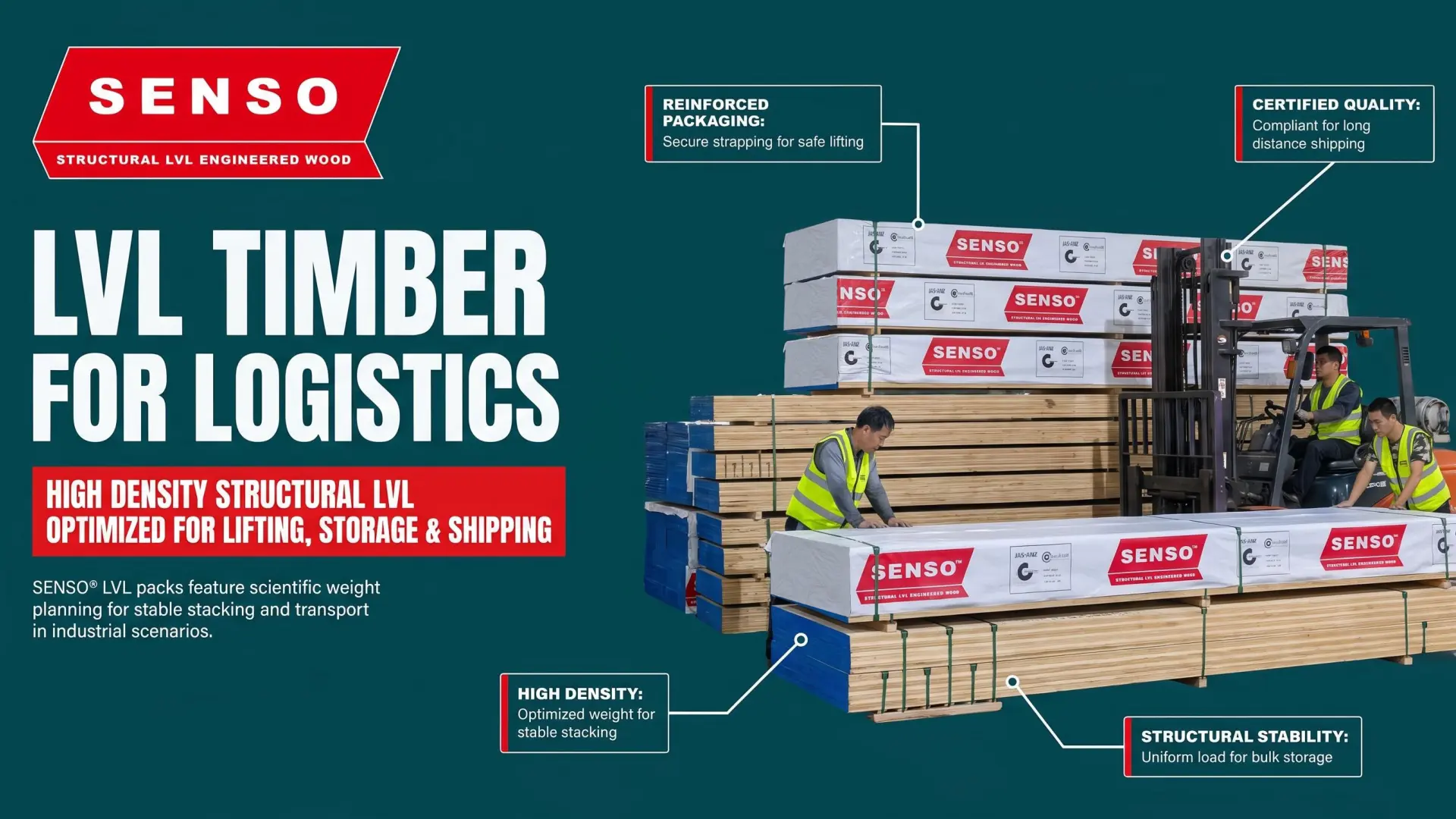
LVL density and weight should be calculated from the verified product density, finished section size, member length, and pack quantity. First, calculate the section volume. Next, multiply it by density to estimate member weight. Then add all members, bearers, wrapping, straps, and other packing materials. This method supports lifting, storage, truck, and shipment planning. However, estimated weight does not replace a final weighbridge result or verified container gross mass.
What LVL Density and Weight Mean
Density describes how much mass exists within a set volume. For structural timber products, suppliers usually state density in kilograms per cubic metre.
Weight describes the mass of a real member or pack. Therefore, density and weight are related, but they are not interchangeable.
A technical review should separate five terms:
| Term | Meaning | Main buyer use |
|---|---|---|
| Product density | Mass per unit volume | Member-weight calculations |
| Weight per metre | Mass of one metre of a stated section | Handling and cut-list planning |
| Member weight | Mass of one full-length piece | Manual or mechanical lifting |
| Pack net weight | Mass of the LVL members only | Pack planning |
| Pack gross weight | Members plus packing materials | Storage, transport, and shipping |
APA identifies LVL as a structural composite lumber product made from bonded wood veneers. However, product construction and species can vary between manufacturers and grades. Therefore, buyers should use the density stated for the exact product rather than a general value found online.
Formula for LVL Weight per Metre
The basic calculation is straightforward.
Metric Formula
Section area in m²
= Width in mm × Depth in mm ÷ 1,000,000

LVL weight per metre in kg/m
= Width in mm × Depth in mm × Density in kg/m³ ÷ 1,000,000

Full member weight
= Weight per metre × Member length in metres

Pack net weight
= Member weight × Number of members

Estimated pack gross weight
= Pack net weight + Bearers + Wrapping + Straps + Other packing
For example, a wider or deeper section contains more wood volume. As a result, its weight rises even when density and length remain unchanged.
The calculation should use finished dimensions. Nominal dimensions can give the wrong answer when machining, sanding, or treatment changes the final section.
Worked Example for One LVL Beam
Consider one illustrative member with these inputs:
| Input | Example value |
|---|---|
| Width | 45 mm |
| Depth | 240 mm |
| Length | 6.0 m |
| Assumed density | 600 kg/m³ |
The assumed density is used only to explain the calculation. It is not a declared SENSO product value.
Weight per metre: 45 × 240 × 600 ÷ 1,000,000 = 6.48 kg/m.
Full member weight: 6.48 × 6.0 = 38.88 kg.
Therefore, the estimated LVL beam weight is 38.88 kg before labels, coating, moisture variation, or other product-specific changes.
From LVL Beam Weight to Pack Weight
A pack calculation starts with the individual member.
If the example pack contains 30 members, its net product weight is 38.88 kg × 30 = 1,166.40 kg.
If bearers, wrapping, straps, corner protection, and labels add 35 kg, the estimated gross pack weight becomes 1,201.40 kg.
The estimated LVL pack weight is therefore about 1,201 kg. In practice, the packing allowance should come from a real pack record.
LVL Timber Density and Moisture
LVL timber density is not independent of moisture condition. Wood mass can change as it gains or loses moisture.
The USDA Wood Handbook explains the relationship between wood density, specific gravity, and moisture content. Therefore, the moisture basis must be understood when comparing density data.
- Factory production
- Covered storage
- Long sea transit
- Wet-site exposure
- Treatment
- Conditioning
- Final delivery
Two packs with the same sections and piece count may not have exactly the same actual mass.
Treatment can also affect weight. Preservative uptake, surface coatings, edge sealing, and retained moisture may change the finished figure.
How Section Size Changes Weight
Section area has a direct effect on LVL weight per metre.
The table below uses the same illustrative density of 600 kg/m³. It is a calculation example, not a SENSO weight table.
| Finished section | Calculated weight per metre |
|---|---|
| 45 × 90 mm | 2.43 kg/m |
| 45 × 140 mm | 3.78 kg/m |
| 45 × 190 mm | 5.13 kg/m |
| 45 × 240 mm | 6.48 kg/m |
| 63 × 300 mm | 11.34 kg/m |
Length then multiplies the result. A 12-metre member weighs twice as much as a 6-metre member of the same section and density.
Buyers can review common LVL beam sizes before building a weight schedule.
Pack Planning for Handling and Storage
Pack planning should start with the limits of the handling system.
- Forklift rated capacity
- Load centre
- Fork length
- Crane or hoist capacity
- Sling arrangement
- Rack capacity
- Bearer position
- Pack width and height
- Ground condition
- Unloading space
The forklift rating shown on the data plate may fall as the load centre increases. Therefore, the nominal forklift capacity alone may not approve a long LVL pack.
The SENSO LVL product range should be reviewed with the proposed bundle size, member length, and unloading method.
LVL Shipping Weight and Container Planning
LVL shipping weight includes more than the calculated timber mass.
- LVL members
- Timber bearers
- Straps
- Wrapping
- Edge protection
- Labels
- Dunnage
- Securing materials
- Container tare mass
The International Maritime Organization requires the gross mass of a packed container to be verified before loading. A planning spreadsheet does not replace the required verified gross mass.
Container decisions must also consider volume and loading layout. A shipment may reach a weight limit before it fills the available space.
What Buyers Should Ask the Supplier
- Product name and grade
- Finished width and depth
- Member length
- Pieces per size
- Density used for planning
- Moisture or density basis
- Treatment and coating details
- Calculated weight per metre
- Calculated member weight
- Pieces per pack
- Net product weight
- Gross pack weight
- Pack dimensions
- Bearer and strap details
- Total shipment estimate
- Final weighing method
The supplier should state whether each figure is calculated, typical, or measured.
Buyers can review structural LVL applications before confirming sections, lengths, and packing.
Common Weight Calculation Errors
Using a Generic Density for Every Product
Species, layup, treatment, and moisture can change the real result. Therefore, one online value should not be used for every LVL grade.
Mixing Millimetres and Metres
Width and depth must be converted correctly. Missing the division by 1,000,000 creates a major error.
Using Nominal Instead of Finished Size
The shipped section may differ from a nominal description. Always use the approved finished dimensions.
Forgetting Packing Materials
Bearers, straps, wrapping, labels, and dunnage add mass. A net product total is not the gross pack total.
Treating an Estimate as a Measured Weight
A calculated LVL pack weight supports planning. It does not prove the final shipment mass.
Questions Buyers Ask
Does a Higher Density Mean Stronger LVL
Not automatically. Density and structural design properties are different data points. Buyers should use verified product properties for structural comparison.
Should Weight Be Calculated From Nominal Size
No. The best estimate uses finished width, depth, and length.
Can One Weight per Metre Apply to Every Length
Yes, when the section and density remain the same. Multiply the weight per metre by each finished length.
Should Treatment Be Included
Yes. The supplier should explain whether the planning density or measured weight includes treatment, coating, and retained moisture.
Is Calculated Weight Enough for Export Shipping
No. Calculated mass supports the loading plan. The final shipment must follow the applicable weighing and verified-gross-mass requirements.
Better Pack Plans Start With Verified Inputs
LVL density and weight connect product dimensions with handling, packing, storage, and transport.
The calculation starts with finished width, depth, length, and verified density. Next, the buyer calculates the member and pack net weight. Finally, packing materials and other shipment items must be added.
However, planning accuracy depends on input quality. Generic density figures, nominal dimensions, or missing packing mass can create serious errors.
For current SENSO sections, planning density, pack configuration, marking, and shipment support, contact the SENSO team.
Post time: Aug-10-2026