

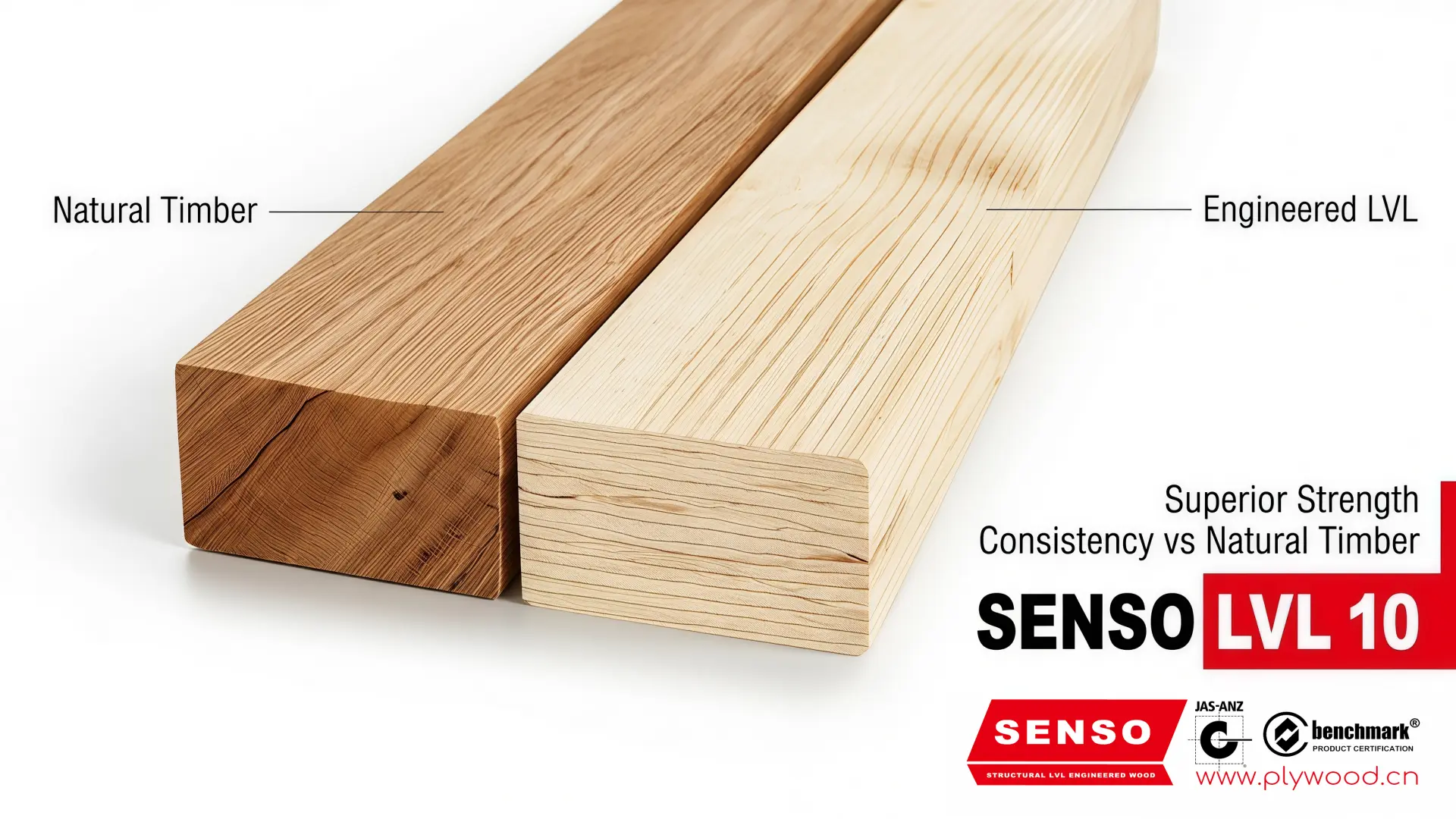
LVL strength consistency describes how closely members from the same checked product can repeat the same strength and size range. The main reason is veneer grading and controlled lamination. Instead of relying on one sawn timber section with all its knots and grain changes in fixed places, LVL spreads many thin veneers through a planned layup. This can reduce variation. However, it does not mean every LVL grade has the same strength or that natural timber is unsuitable.
What LVL Strength Consistency Means
Consistency does not mean maximum strength. It means the product keeps its properties within a controlled range.
For a buyer, LVL strength consistency matters because one shipment may contain hundreds of members. Each marked grade should match the current product data used for the order.
LVL uses thin wood veneers bonded into a billet, with most veneer grain running along the member length. APA describes LVL as structural composite lumber made from bonded veneers and then cut to the required size.
Therefore, the main buyer benefit is repeat supply. A controlled mill can sort veneers, manage moisture, set the layup, press the billet, and check the product.
Why Natural Timber Shows More Variation
Natural timber comes from trees, so each piece starts with natural differences. Knots, grain direction, growth rate, density, moisture, and local defects can all change from one board to another.
For example, two boards from the same log can differ. One may carry a knot near the edge, while another has straighter grain. Knots and grain variation can both change how load moves through the member.
Still, this does not make natural timber a poor building material. Structural lumber grading sorts pieces into useful grades.
The key difference is location. A sawn member keeps many natural features where the tree grew them. By contrast, LVL production peels the log into thin veneers, checks those veneers, and rebuilds them in a planned order.
That is the useful point in LVL vs natural timber when the question is repeat supply rather than a full product comparison.
Veneer Grading Controls the Starting Material
Veneer grading is one of the main ways a mill can improve engineered wood consistency.
Before layup, the mill can inspect or measure each veneer. Staff or machines may check visible defects, moisture, veneer quality, or stiffness-related signals. Next, the mill groups the veneers and places suitable sheets where the product plan needs them.
As a result, one large feature in the original log does not always stay as one large feature through the full LVL section.
USDA research on parallel-laminated veneer describes visual, machine, and stress-wave methods used to grade veneer before manufacture.
However, clean veneers alone do not prove the final grade. The mill must connect veneer grading with layup control, bond checks, marks, and test records.
How Lamination Spreads Knots and Grain Variation
Lamination changes where natural wood features sit inside the finished member.
A knot in solid timber may take up a large share of one cross section. In LVL, the mill first peels the log into thin veneers. It then spreads those veneers through many layers.
USDA Forest Products Laboratory research explains that wood composites can show less property variation than lumber because the process divides and spreads natural defects through the product.
This helps explain LVL strength consistency. The process does not remove natural variation. Instead, it changes how that variation is spread.
Most LVL veneers run along the member length. Therefore, the billet can keep a more even structure from one area to another.
However, buyers should not say LVL has no knots or grain variation. Veneers are still real wood. The benefit is better control, not the total removal of natural features.
Engineered Wood Consistency Depends on Process Control
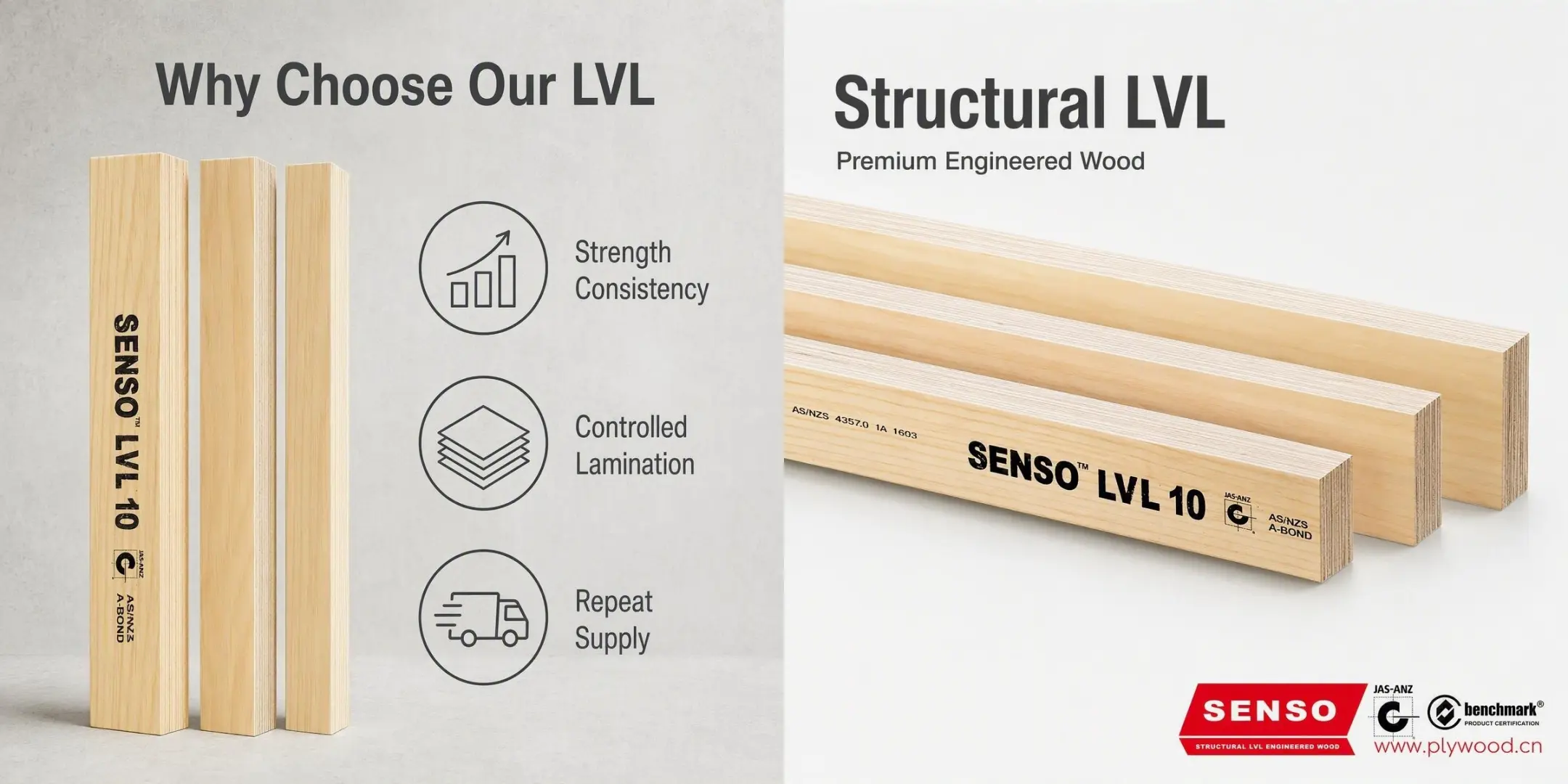
Engineered wood consistency depends on the whole production line, not on the number of layers alone.
- Log and veneer selection
- Veneer thickness
- Drying and moisture control
- Veneer grading
- Joint position
- Adhesive spread
- Layup order
- Press heat and pressure
- Finished size
- Testing and product marking
For example, uneven veneer moisture can affect bonding, while poor joint placement can create weak zones. Therefore, LVL strength consistency comes from linked controls across raw wood, bonding, pressing, size checks, and final testing.
What Consistency Does Not Mean
Consistency can be easy to overstate.
First, it does not mean all LVL grades have the same properties. Products may use different species, veneer groups, layups, glues, treatments, or target grades.
Second, it does not mean every test result is identical.
Third, it does not mean LVL is always stronger than natural timber. A fair check needs the exact products, grades, sizes, and design values.
Finally, consistency does not replace design.
AS/NZS 4357.0:2022 covers manufacture, structural characterisation, and structural verification for LVL used in structural work.
Therefore, buyers need checked product data rather than a broad claim that engineered wood is always better.
How Buyers Should Compare Repeat Supply
A useful review should compare evidence, not just surface appearance.
| Check | What to review | Why it matters |
|---|---|---|
| Product identity | Brand, grade, size, treatment | Links the member to the right data |
| Veneer control | Grading method and layup plan | Shows how raw variation is managed |
| Finished size | Width, depth, length, straightness | Supports repeat cutting and fitting |
| Structural data | Current checked properties | Defines the product used for design |
| Batch marking | Product and batch details | Links packs to records |
| Documents | Current scope and date | Reduces use of old data |
Buyers can review available LVL beam sizes before preparing an order. However, size consistency alone does not prove strength consistency.
Likewise, a smooth surface is not enough. The more useful checks sit in the product system behind the face.
Product Marking Supports Batch Tracking
Product marking gives buyers a practical way to check repeat supply.
A member or pack mark may show the brand, grade, size, treatment, batch, or product code.
Marking systems vary by market. Therefore, buyers should ask for a current example before shipment.
This helps when one order includes several grades or sizes. Clear labels help warehouse teams keep packs separate.
Therefore, buyers should review the SENSO LVL product range with current product data and pack marks, not as a product name alone.
In addition, buyers should match each member to its intended structural LVL application.

Where Natural Timber Still Fits
A discussion of LVL strength consistency should not suggest that natural timber has no place in construction.
Natural structural timber can suit many framing jobs when designers select the correct species and grade.
LVL becomes useful where a project values controlled properties, long members, repeat dimensions, or checked product data.
Therefore, the buyer should ask which product gives the required grade, size, documents, supply, and design performance for the job.
A separate LVL versus solid timber guide can compare cost, machining, appearance, waste, and use. This article stays focused on repeat supply.
Questions Buyers Ask
Does LVL Have No Knots
No. LVL uses real wood veneers. Natural features can remain. However, grading and lamination can spread those features through the billet instead of leaving one large feature in one sawn section.
Is LVL Always Stronger Than Natural Timber
No. Strength depends on the exact products and grades. LVL strength consistency describes controlled repeat supply, not a claim that every LVL product is stronger.
Why Does Veneer Grading Matter
Veneer grading lets the mill check and sort thin wood sheets before layup. As a result, the final product follows a planned structure rather than one unchanged sawn section.
Does a Straight Beam Prove Structural Consistency
No. Straightness helps with handling and fitting. However, strength consistency also depends on checked properties, process control, product marks, and current documents.
Better Repeat Supply Starts With a Checked Product System
LVL strength consistency comes from managing natural wood variation through veneer grading, planned lamination, bond control, production checks, and product proof.
The benefit is not the removal of every knot or grain change. Instead, the mill gains more control over where those features sit.
Therefore, buyers should compare marked grades and current data rather than rely on appearance or broad claims.
For current SENSO LVL grades, size ranges, product data, pack marks, and supply details, contact the SENSO team.
Post time: Aug-24-2026