
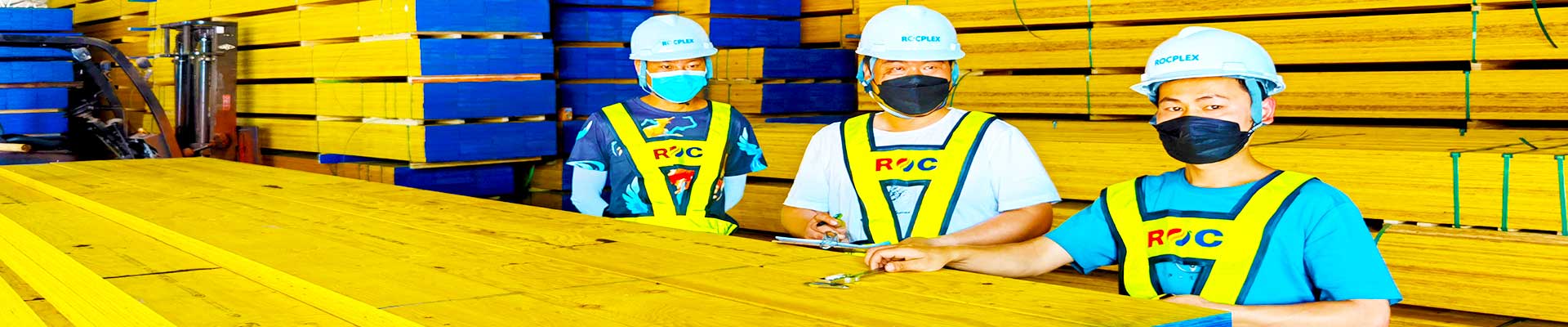
Buyers asking “how is LVL made?” need a clear view of the full production line. Laminated veneer lumber starts with logs that are peeled into thin veneers. The veneers are then dried, graded, joined, glued, and laid mainly in one direction. Heat and pressure form the layup into a large billet. Finally, the billet is cooled, cut, tested, marked, and packed. Each step affects bond quality, finished size, structural properties, and repeat supply.
How Is LVL Made in Simple Terms
LVL means laminated veneer lumber. It belongs to the structural composite lumber family. Unlike solid timber, manufacturers build it from many thin wood veneers.
Most veneer grain runs along the member length. Therefore, the finished product works well as a beam, stud, flange, plank, or formwork member. Some products also use selected cross veneers.
The APA Structural Composite Lumber resource describes structural composite lumber as dried and graded wood elements bonded into billets. Manufacturers then cut those billets into set sizes.
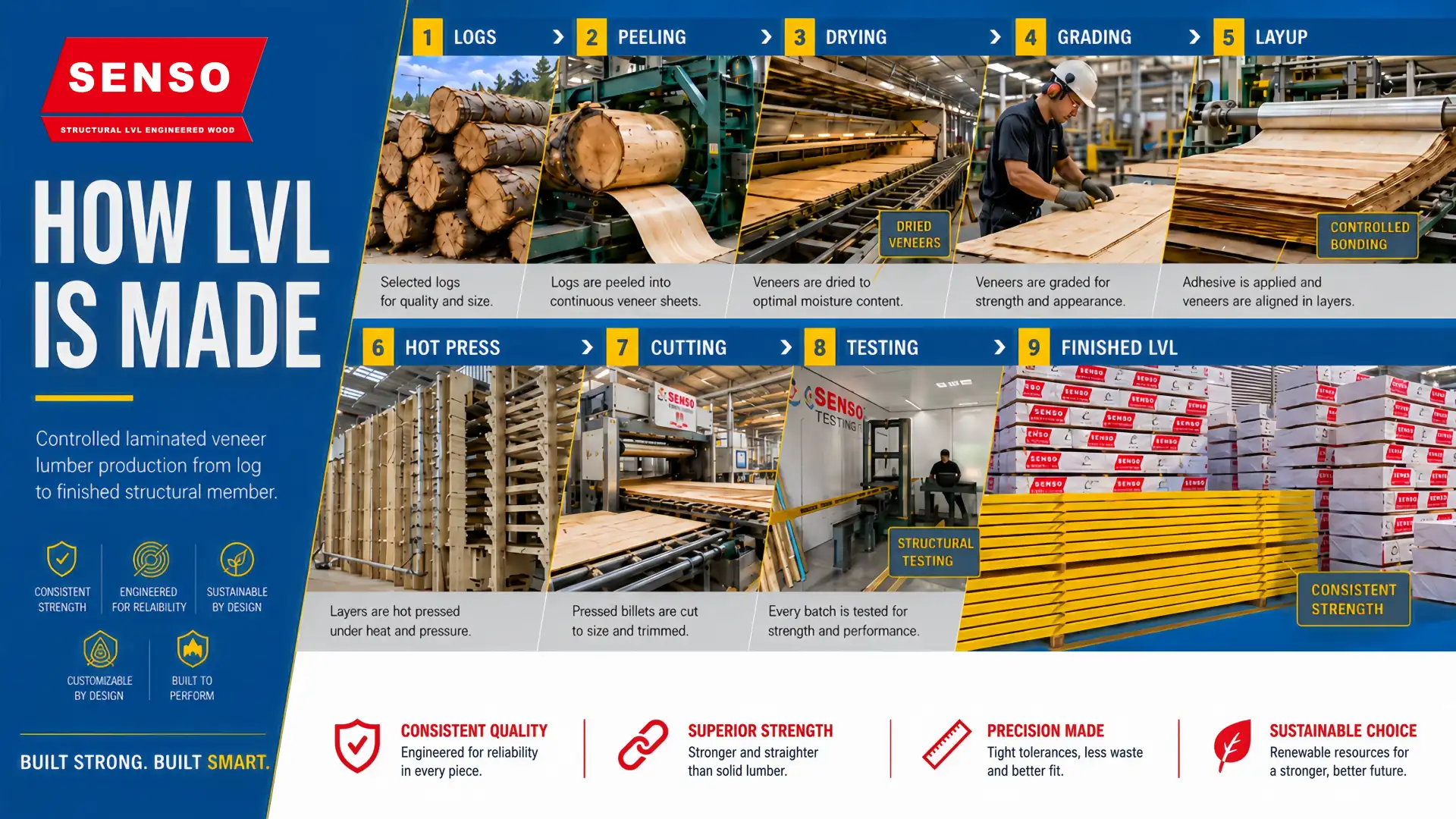
In practical terms, how is LVL made can be answered through nine linked stages:
- Log preparation
- Veneer peeling
- Veneer drying
- Veneer grading
- Veneer jointing
- Adhesive spread and layup
- Hot pressing
- Cutting and testing
- Marking and packing
A weakness in one stage can affect the finished member. Therefore, mills must control the whole process rather than rely only on final inspection.
From Raw Logs to Veneer Sheets
The process starts with suitable logs. Species, diameter, growth pattern, and log condition can affect veneer quality.
First, the mill removes bark and cleans the log surface. Some mills also heat or condition logs before peeling. This step can help the wood cut more evenly.
Next, a rotary lathe turns the log against a long knife. The machine peels a continuous ribbon of thin veneer. A clipping line then cuts the ribbon into sheets.
Cameras or trained operators remove large splits, missing areas, and other weak sections. However, minor natural marks may remain when the approved product grade allows them.
Veneer thickness must stay within the planned range. Thick and thin areas can affect glue spread, final thickness, and pressure inside the billet.
Because the veneers remain separate at this stage, the mill can sort them before assembly. This gives the producer more control than cutting a beam from one natural log.
Veneer Drying and Grading
Fresh veneer contains too much water for a stable adhesive bond. Therefore, each sheet passes through a dryer before gluing.
The dryer lowers moisture to a range set by the production plan. Veneer that remains too wet may affect adhesive cure. In contrast, veneer dried too hard may become brittle or difficult to handle.
The drying line must balance:
- Dryer temperature
- Airflow
- Veneer thickness
- Feed speed
- Final moisture
- Veneer condition
After drying, the mill grades each veneer. Visual systems may check knots, splits, grain, missing wood, and surface faults. Some production lines also use sound or ultrasonic tools to estimate stiffness.
The USDA Forest Products Laboratory notes that careful veneer selection helps producers meet the target properties of structural composite lumber.
Grading allows the mill to create controlled veneer groups. Better veneers may be placed where they provide the most value. Meanwhile, suitable lower grades may be used in less critical parts of an approved layup.
Creating Continuous Veneer Layers
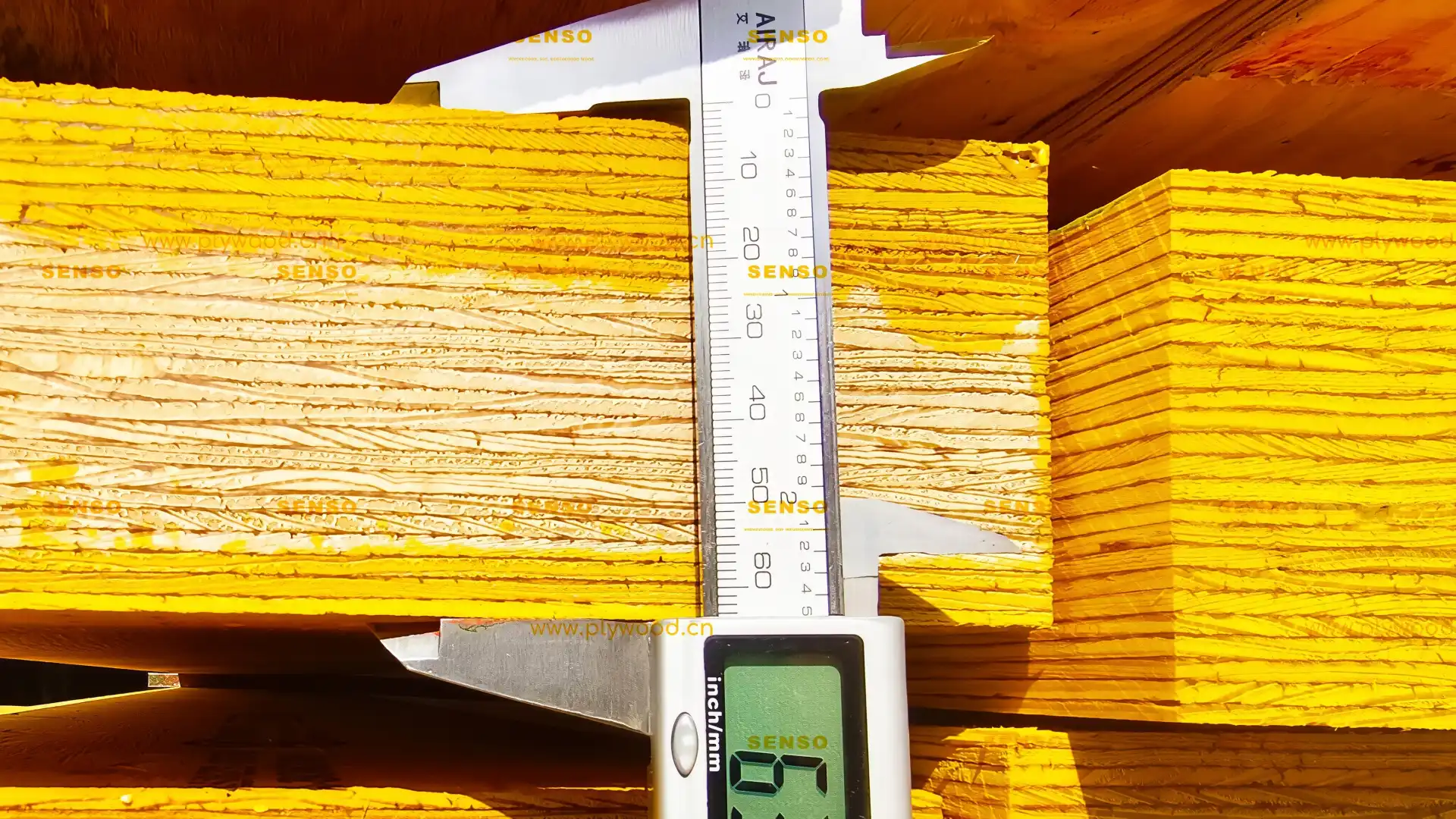
One veneer sheet cannot normally cover the full length of a long LVL billet. Therefore, mills join veneer ends before or during assembly.
Common joint methods include:
- Scarf joints
- Lap joints
- Butt joints
- Finger joints
The method depends on the product, equipment, and approved production plan.
The mill should also stagger joints between layers. In other words, several veneer joints should not form one weak line through the section.
Joint quality depends on cut accuracy, joint position, overlap, adhesive spread, veneer moisture, and pressure during bonding.
A long, smooth outer face does not prove that all inner joints are sound. For this reason, buyers should also review production records and test results.
Veneer Layup and Adhesive Control
During veneer layup, adhesive is spread across the veneer faces. The sheets are then stacked in the planned order.
Most veneers run parallel with the billet length. This layup gives LVL its main long-direction properties. However, some products include selected cross veneers for a specific design purpose.
Glue spread must remain even. Too little adhesive may leave weak bond areas. Too much adhesive adds cost and can make process control harder.
The production line must also control the time between adhesive spread and pressing. If the layup waits too long, the adhesive may not cure as planned.
Key controls include adhesive type, adhesive mix, spread rate, veneer moisture, layup order, grain direction, and assembly time.
Buyers should not identify an adhesive only from its colour. Instead, they should check product data, test reports, and the stated end-use condition.
Hot Pressing Forms the Billet
Once the layup is ready, the press applies heat and pressure. This bonds the veneer layers into one dense billet.
Some mills use batch presses. Others use continuous pressing systems. Both methods require firm control over the main settings.
| Press control | Why it matters |
|---|---|
| Temperature | Helps the adhesive cure |
| Pressure | Brings the veneer faces into close contact |
| Pressing time | Allows the bond to form |
| Line speed | Controls time in a continuous press |
| Target thickness | Sets the finished billet size |
If one setting moves outside the approved range, the billet may develop weak bonds, uneven thickness, blisters, or other faults.
Therefore, press records form an important part of quality control. These records can help the mill trace a problem back to a production period or batch.
Cooling Cutting and Size Checks
A newly pressed billet is not ready for shipment at once. First, it needs time to cool and settle.
Next, saws trim the edges and cut the billet into the required widths, depths, and lengths. Depending on the product, the mill may also sand, seal, treat, chamfer, or coat the member.
Finished checks may include thickness, width, length, straightness, squareness, surface condition, edge condition, and cut quality.
These checks matter because buyers often use LVL with hangers, wall frames, connectors, or factory jigs.
Even a well-bonded billet can cause site problems if its size is wrong. For example, a width error may affect hanger fit. A depth error may affect floor or roof alignment.
Buyers can review common LVL beam sizes before preparing an order. However, custom sizes and lengths still need production approval.
Testing Marking and Traceability
Testing connects the manufacturing controls with the final product claim. The exact test plan depends on product grade, market, standard, and quality system.
- Moisture content
- Finished dimensions
- Density
- Bond quality
- Bending
- Stiffness
- Shear
- Surface and edge faults
Mills may take samples by batch, production period, size, or another approved system.
AS/NZS 4357.0:2022 covers requirements for the manufacture, structural characterisation, and verification of structural laminated veneer lumber.
Therefore, a statement that a factory produces structural LVL is not enough by itself. Buyers should check the product data, marking, test basis, and document scope.
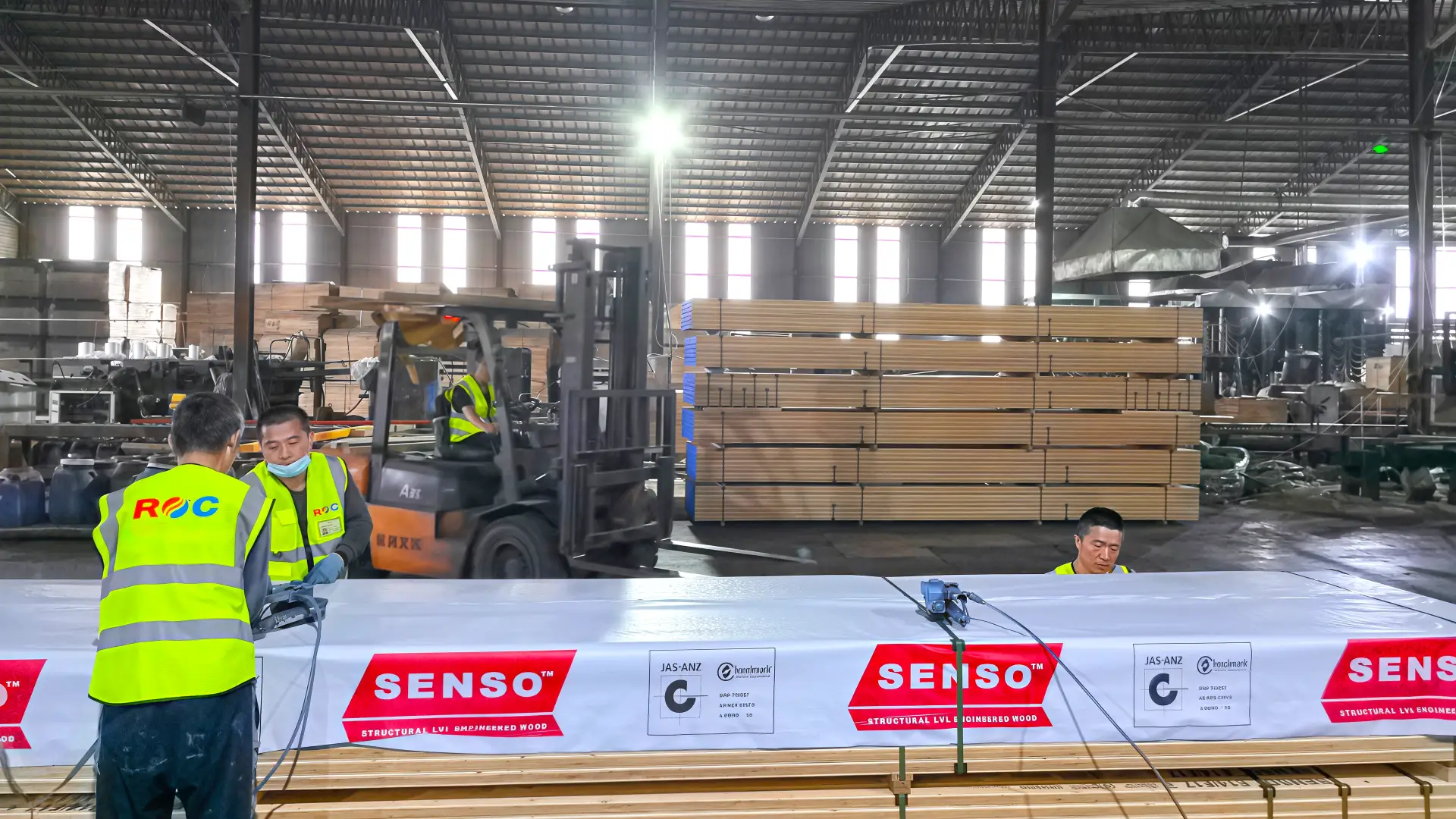
After approval, the mill marks each member or pack. A useful mark may include the brand, product type, grade, size, treatment, batch number, standard reference, and production date.
Clear marking helps buyers connect the product to the packing list, test record, inspection file, and shipment documents.
How Is LVL Made Differently From Plywood
LVL and plywood both use wood veneers. However, their layups and final forms serve different purposes.
| Production point | LVL | Plywood |
|---|---|---|
| Main grain direction | Mostly along the member length | Changes between layers |
| Main product form | Long billet or lineal member | Flat panel |
| Final cutting | Beams, studs, planks, or flanges | Standard sheet sizes |
| Common use | Beams, lintels, studs, and formwork | Flooring, walls, panels, and form faces |
| Main production aim | Long-direction properties and steady sections | Panel stability in two directions |
Because of this difference, plywood production cannot be used as a direct model for every LVL product.
LVL production places greater focus on long member continuity, veneer joints, lineal cutting, straightness, and end-use marking.
The wider laminated veneer lumber resource explains how LVL differs from other engineered wood products.
What Buyers Should Check During Production
A useful factory inspection should follow the material from logs to finished packs.
- Veneer species and source
- Veneer thickness
- Dryer records
- Moisture checks
- Grading method
- Joint type and spacing
- Adhesive control
- Layup plan
- Grain direction
- Press records
- Finished dimensions
- Straightness
- Test frequency
- Batch marks
- Pack labels
- Wrapping and storage
A clear answer to the focus question must match the final product claim. Framing LVL, formwork LVL, scaffold planks, and factory-use LVL may require different controls.
Therefore, a factory should not use one general data sheet for every product type.
Buyers can also review structural LVL applications before selecting the grade, size, treatment, or production option.
Common Questions About LVL Production
Is One Wood Species Always Used
No. The wood species depends on the product, factory, market, and approved design. Buyers should check the current technical data rather than assume one species.
Do All Veneers Run in the Same Direction
Most veneers run along the member length. However, some products include selected cross veneers. The actual layup forms part of the product design.
Does Hot Pressing Make Every Beam Structural
No. Pressing creates a bonded billet. Structural use also requires an approved product design, production control, test data, and clear marking.
Can Surface Appearance Prove Quality
No. The surface can show finish and handling quality, but it cannot prove inner bond strength. Test results and traceable records provide stronger evidence.
Controlled Production Supports Reliable Supply
The answer to “how is LVL made?” involves a chain of controlled steps rather than one machine.
The mill must control logs, peeling, veneer drying, grading, joints, adhesive, layup, hot pressing, cutting, testing, marking, and packing.
When these stages work together, LVL can provide steady dimensions and repeat supply. However, final inspection may not fully correct a fault created during drying, grading, gluing, or pressing.
For current SENSO grades, dimensions, treatment options, packing details, and technical files, contact the SENSO team.
Post time: Jul-20-2026